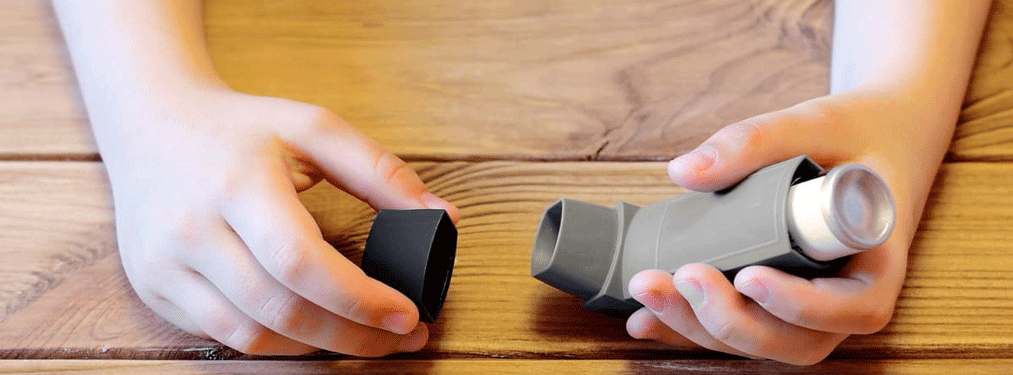

Inhalers are the primary method for managing asthma and Chronic Obstructive Pulmonary Disease (COPD). They are small, handy devices that store and deliver your asthma and COPD medicines, and they can be used for both maintenance and quick relief during attacks.1
There are several types of inhalers, with different uses and advantages. But they can be tricky to handle. When they aren’t used properly, the dose that you get may be smaller than prescribed, and your symptoms might not be controlled.1
So then, how do we use our inhalers properly?
There are three main types of inhalers for asthma available:
- Pressurized metered-dose inhaler (pMDI),
- Soft mist inhaler (SMI).1
- Dry powder inhaler (DPI)

Each device is prepared and used differently, so it is important to identify what type of inhaler you have.
PRESSURIZED METERED-DOSE INHALER
Pressurized metered-dose inhaler devices, also called “puffers”, hold the medicine in a pressurized canister. When you press on the canister, the medicine is pushed out of the mouthpiece and into your airways. A spacer is sometimes attached to the inhaler to make it easier to time your inhalation of the medicine.1
When using the inhaler for the first time, it must be prepared or “primed”. To do this, we:
- Take off the cap.
- Shake the inhaler for 5 seconds.
- Press down the canister to spray the medicine into the air.
- Repeat steps 2-3 three more times, for a total of four times.2
Most inhalers must be primed if you haven’t used them for more than 2 weeks, while some need to be primed after 1 week.2 Always refer to your inhaler’s product information placed inside the box, as different inhalers have specific instructions for priming. It’s also best to ask your doctor or pharmacist for help.
To use the inhaler, do the following:
- Take off the cap.
- Shake the inhaler for 5 seconds.
- If you are using a spacer, put the inhaler in the rubber ring of the spacer.
- Hold the inhaler with your finger on top of the canister, and your thumb holding the bottom of the inhaler.
- Exhale normally through your mouth.
- Close your lips around the mouthpiece tightly to form a seal.
- As you inhale through your mouth, press down on the canister.
- Keep inhaling slowly and deeply through the mouth for 3 to 5 seconds.
- When your lungs are full, hold your breath for 10 seconds to make sure that the medicine stays in the lungs.
- Remove your mouth from the inhaler. Exhale.
- Wait 15 to 30 seconds before taking the second puff. Shake the inhaler again before the second puff.
- Put the cap back on the mouthpiece.2
If you are using a combination drug with an inhaled glucocorticoid/steroid, make sure to rinse and gargle your mouth out with water.2
SOFT MIST INHALERS
Soft mist inhalers turn the medicine into a fine mist. When the inhaler is pressed, the medicine is sprayed into a fine mist that you breathe in through your mouth and into the lungs.1
Before using the inhaler, you must insert the cartridge first. Press the safety catch to remove the clear base and pull it out. Insert the narrow end of the cartridge and press it in. You can push the device down on a hard surface to fully press the cartridge in.4
To prime the inhaler, you:
- Hold the inhaler upright with the cap closed.
- Twist the clear base in a half turn until you hear a click.
- Open the cap. Point the inhaler away from you.
- Press the dose release button and release up to 4 sprays.
- Close the cap.4
If you have not used your inhaler for over 7 days, do one priming cycle to release 1 spray. If it has been longer than 3 weeks, do four priming cycles to release 4 sprays of medicine.4 You can also refer to your inhaler’s product information for priming instructions.
To use the SMI, you:
- Hold the inhaler upright with one hand, with the cap closed.
- Twist the clear base in a half turn following the arrow on the label until you hear a click. Open the cap.
- Exhale slowly and completely.
- Close your lips tightly around the mouthpiece and hold the inhaler horizontally.
- Inhale slowly and deeply. At the same time, press the button on the side of the inhaler to spray the mist.
- Once your lungs are full, hold your breath for 10 seconds to keep the medicine in the lungs.
- Remove the mouthpiece from your mouth and exhale slowly.
- Put the cap back on the mouthpiece.4
DRY POWDER INHALERS
Unlike PMDIs and SMIs, dry powder inhalers store the medicine as a powder. Instead of the device spraying the medicine at you, you must use a quick deep breath to pull the medicine out and into your lungs. These inhalers are usually tube- or disk-shaped.1
There are 2 main types of DPIs: single-dose and multiple-dose inhalers. There are specific instructions for priming and loading of doses, so be sure to follow the product information on your inhaler’s box.
To use the DPI, we:
- Open the inhaler.
- Load a dose of the medicine as shown in the instructions.
- Hold the inhaler in the correct position. Most multiple-dose inhalers are held horizontally, while some inhalers are held upright.
- Exhale normally.
- Close your lips around the mouthpiece tightly to form a seal.
- Inhale quickly and deeply as possible.
- Hold your breath for 10 seconds.
- Remove your mouth from the mouthpiece. Exhale slowly.
- If you are supposed to take 2 puffs, wait 1 minute between doses.
- Close the inhaler.3
Rinse out your mouth and gargle with water. If you are using a single-dose inhaler, take out the used pill and throw it away.3
As you can see, there are different inhalers for asthma relief. Learning about them can be overwhelming, but with these steps broken down, understanding how to treat asthma can get easier. Knowing how to properly use these inhalers helps control your symptoms better, and in the long run, can reduce your hospital visits, lessen your expenses, and improve your quality of life.
Managing asthma means understanding its common triggers. Explore our Wellness and Prevention tips to learn more.
References:
- Inhalers https://my.clevelandclinic.org/health/treatments/8694-inhalers
- How to Use a Metered Dose Inhaler https://www.nhlbi.nih.gov/sites/default/files/publications/How-to-Use-a-Metered-Dose-Inhaler_21-HL-8165.pdf
- How to Use a Dry Powder Inhaler https://www.nhlbi.nih.gov/sites/default/files/publications/How-to-Use-a-Dry-Powder-Inhaler_21-HL-8164.pdf
- Inhaler devices https://healthify.nz/medicines-a-z/i/inhaler-devices
Approval ID: PH-12333.
While it's best to consult a doctor,
this quick, self-assessment test
can help you screen yourself for
asthma and/or COPD.

Powered by 
BreatheBetter.com is intended as a service to patients by AstraZeneca Philippines. There is no intent to replace the advice of a healthcare professional. Always consult your doctor.
“Breathe Better is a non-promotional program initiated & developed by AstraZeneca”
CONNECT WITH US

